Ancient Occult ✧ Curiosity beyond the everyday
✺Ancient OccultWear the unseen
The cosmic observatory / science & discovery

Into the
unknown.

From the invisible mass holding galaxies together to the quantum structure of spacetime. Explore the questions that keep the universe interesting.

Seven fields · selected experts · daily source checks
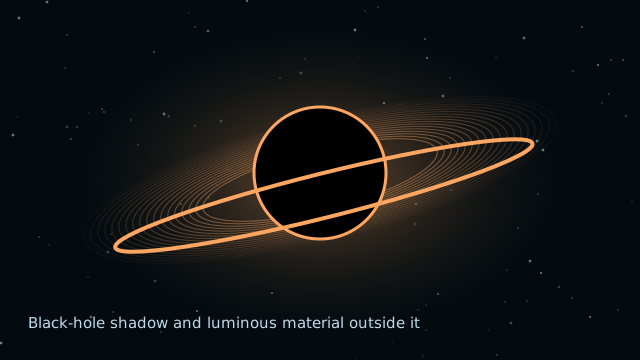
Illustrated black-hole shadow surrounded by a tilted accretion disk
At the edge of what we know.Conceptual illustration, not observational data.
The daily research desk

Fresh questions.
New evidence.

Selected topic matches from arXiv and NASA. arXiv entries are research preprints and may not have been peer reviewed. A new paper is a claim to examine, not automatically an established discovery.

Loading the research desk…

Not a complete literature index. Source publication dates appear on each entry. Quiet days may have no new matches. Search all of arXiv ↗ · NASA Universe ↗

A field guide to the frontiers

Meet the questions.
Meet the researchers.

Selected influential researchers across these fields, rather than a ranking of “the best.” Profiles checked September 25, 2026. Research papers refresh separately from these editorial profiles.

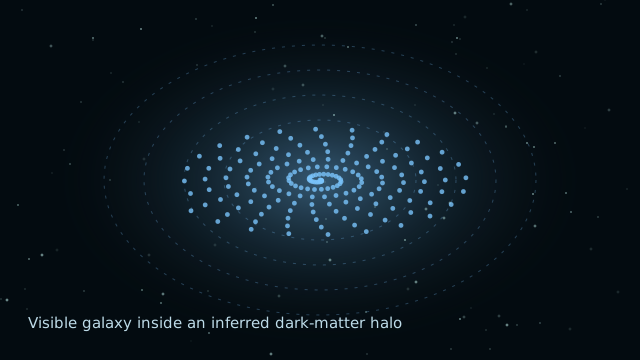
Dark matter: conceptual scientific illustration
Conceptual illustration · not a telescope image
01 / The invisible architecture

Dark matter

Galaxies and galaxy clusters behave as though they contain much more mass than we can see. Dark matter is the name for that unseen contribution. Its gravitational effects are well supported, but its particle identity remains unknown. Researchers compare galaxy motions, gravitational lensing and cosmic structure with searches for new particles.

Strong gravitational evidence · identity unknown

Read the scientific background ↗
A researcher to follow · MIT

Tracy Slatyer

A particle astrophysicist investigating dark matter through theory and possible signals in high-energy astronomical observations. Her work connects particle models with the history and structure of the universe.
Show papers on dark matter ↓
Black holes: conceptual scientific illustration
Conceptual illustration · not a telescope image
02 / Where gravity takes over

Black holes

A black hole contains a region from which light cannot escape. Astronomers study the matter around it, the motion of nearby stars and gravitational waves from mergers. These observations test general relativity. The event horizon is a boundary, not a solid surface; a bright accretion disk belongs to material outside it.

Observed through multiple independent methods

Read the scientific background ↗
A researcher to follow · UCLA Galactic Center Group

Andrea Ghez

An observational astronomer whose tracking of stars near the Milky Way’s center established compelling evidence for a supermassive black hole. Her group uses stellar orbits to probe gravity and the Galactic Center.

Show papers on black holes ↓
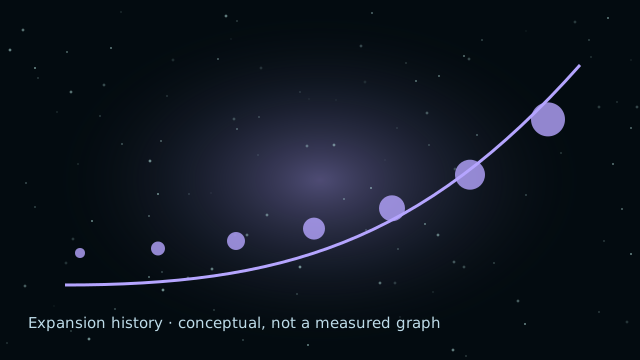
Dark energy: conceptual scientific illustration
Conceptual illustration · not a telescope image
03 / An expanding mystery

Dark energy

The expansion of the universe is accelerating. Dark energy names the unknown contribution used to describe this behavior in the standard cosmological model. A cosmological constant is one possibility. Large galaxy surveys and distance measurements test whether a constant is sufficient or whether its behavior changes over cosmic time.

Acceleration observed · explanation under investigation

Read the scientific background ↗
A researcher to follow · Stanford / KIPAC

Risa Wechsler

A cosmologist studying how galaxies and large-scale structure reveal the universe’s contents and history. Her research and survey work connect galaxy formation with tests of dark matter and dark energy.

Show papers on dark energy ↓
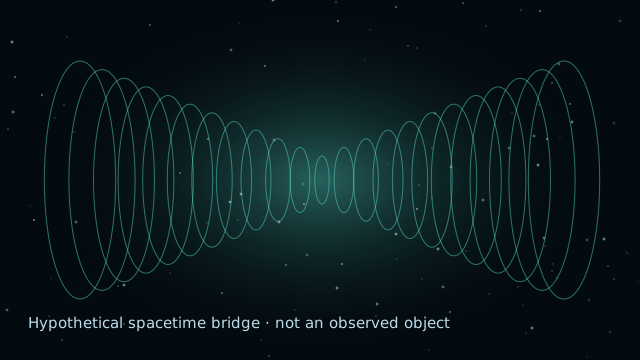
Wormholes: conceptual scientific illustration
Conceptual illustration · not a telescope image
04 / Bridges in the equations

Wormholes

Some solutions and models in gravitational physics connect separated regions of spacetime. Researchers use these ideas to investigate geometry, entanglement and quantum information. No astronomical wormhole has been observed. A mathematical bridge does not automatically allow a person, signal or spacecraft to travel through it.

Theoretical · no observed astronomical examples

Read the scientific background ↗
A researcher to follow · Institute for Advanced Study

Juan Maldacena

A theoretical physicist known for the gauge/gravity correspondence. His research connects quantum field theory, black holes and spacetime, including theoretical relationships between entanglement and wormhole geometry.

Show papers on wormholes ↓
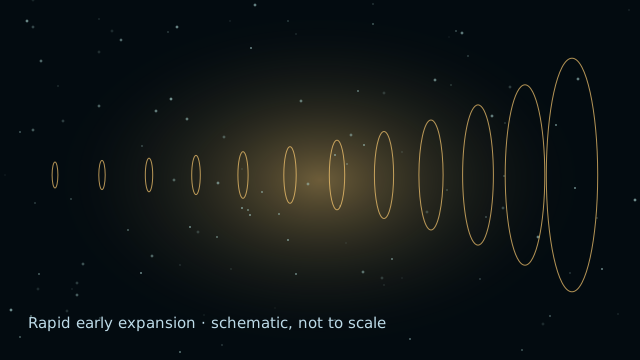
Cosmic inflation: conceptual scientific illustration
Conceptual illustration · not a telescope image
05 / The earliest expansion

Cosmic inflation

Inflation proposes a very early period of accelerated expansion. It offers explanations for the universe’s large-scale uniformity and for the seeds of later cosmic structure. Measurements of the cosmic microwave background constrain inflationary models, but the mechanism and any responsible field have not been directly established.

Influential theoretical framework · models being tested

Read the scientific background ↗
A researcher to follow · MIT

Alan Guth

A pioneer of inflationary cosmology whose research examines the early universe and inflation. His work helps frame questions about cosmic origins, the dynamics of expansion and possible inflationary histories.

Show papers on cosmic inflation ↓
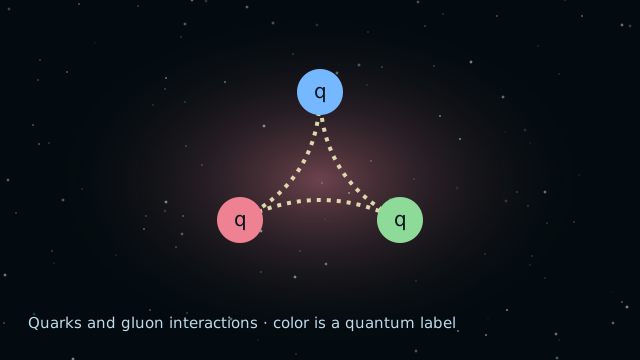
Quantum chromodynamics: conceptual scientific illustration
Conceptual illustration · not a telescope image
06 / Inside the strong interaction

Quantum chromodynamics

Quantum chromodynamics, or QCD, describes the strong interaction between quarks and gluons. Its behavior changes with energy and distance: quarks interact more weakly at very short distances but are confined inside ordinary hadrons. Calculations, collider experiments and lattice simulations investigate this quantum theory and the matter it produces.

Established quantum field theory · active precision research

Read the scientific background ↗
A researcher to follow · MIT

Iain Stewart

A theoretical physicist developing effective field theories for strong interactions and collider physics. These tools make complex QCD processes tractable and connect detailed predictions with experimental measurements.

Show papers on quantum chromodynamics ↓
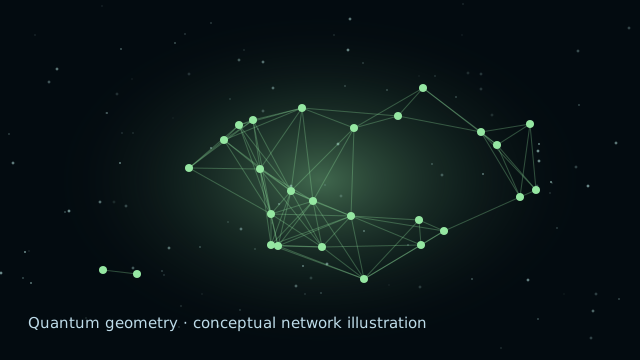
Quantum gravity: conceptual scientific illustration
Conceptual illustration · not a telescope image
07 / Spacetime at its foundations

Quantum gravity

Quantum gravity seeks a consistent description of gravity that also respects quantum physics. Approaches include string theory, loop quantum gravity and other models of spacetime. Researchers study black-hole information, quantum geometry and the early universe. There is no experimentally confirmed complete theory of quantum gravity.

Open research · multiple competing approaches

Read the scientific background ↗
A researcher to follow · Perimeter Institute

Bianca Dittrich

A quantum-gravity researcher developing methods to connect microscopic models of geometry with the large-scale spacetime we observe. Her work includes spin-foam models and the problem of recovering continuum physics.

Show papers on quantum gravity ↓
Explore a black hole’s scale

A horizon grows
with its mass.

For an idealized, nonrotating black hole, the Schwarzschild radius is approximately 2.95 kilometers per solar mass. Change the mass to see the scale.

Schwarzschild radius; rotation changes the geometry.
The lecture room

Stay curious.

Lectures and explainers from working physicists. Tap to load a lecture here, or open it on YouTube. Theories discussed in a lecture may be unsettled.

The Meaning of Spacetime

Juan Maldacena · Perimeter Institute

Wormholes, black holes and quantum entanglement.

Watch on YouTube ↗Source ↗

The Dark Energy Delusion

Claudia de Rham · Perimeter Institute

A public conversation about gravity and accelerated expansion.

Watch on YouTube ↗Source ↗

String Theory Legos for Black Holes

A. W. Peet · Perimeter Institute

How string theory approaches black-hole puzzles.

Watch on YouTube ↗Source ↗

QCD: Quantum Chromodynamics

Don Lincoln · Fermilab

An introduction to quarks, gluons and the strong interaction.

Watch on YouTube ↗

Just What Is Quantum Mechanics?

Don Lincoln · Fermilab

A guide to the meaning of quantum physics and its research applications.

Watch on YouTube ↗
Bring a little wonder with you

Ideas worth exploring.
Designs worth wearing.

Explore Ancient Occult ↗